What happens between ambition and delivery, and why it needs its own discipline
I started my career in live event production. I saw hundreds of events happen and nearly all of them would have appeared flawless to the audience. They never knew the scramble it took to readjust when the next presenter wasn't where we thought they'd be when their time was secondas away from starting. That we had to completely rebuild the show's media in the afternoon because our primary show computer was stolen or damaged in the truck, or that the clip on the RJ45 connector driving our most prominant screen over HDBaseT was broken so it was aggressively gaff taped to stay in.
At the beginning of my career, it was all about making it happen. Make sure the systems and equipment were functional, the audio mix was solid, the slides hit their timing, the lights were safely rigged and interesting to watch. I knew if I did that, I was doing a good job.
On tours that did the same setup and program city after city, a new problem presented itself. Without the opening night energy, and with several "wins" behind us, we got sloppy. Cues would get missed or come noticeably off time. Corners would get cut (not safety ones). I remember walking through the crowd on a break and not hearing the same enthusiasm I typically would. The platitude I knew and carried around finally gained a meaning that was mine. This was the only one of this show that this group would see. Everything was technically running, and it wasn't landing, which seemed even worse. I knew the program and production were strong. I'd seen it hit several times. But I started to realize that we didn't have the same systems in place to make it matter that we had to make it work.
I became a listener. Part of my new ritual at these events was to spend some time roaming the crowd beforehand and a couple of times through it. As much as the technical preparations mattered, this was critical for me. It grounded the audience perspective in my daily operations — the less exciting time after opening.
Next was a phase of limits. It was all about efficiency. What was the minimum we needed to do to accomplish the objective? Do we need a lot of media changes and synchronized audio, lighting, and performer cues to get the moment we actually need? It sounds cool, but it would be much more repeatable to constrain the performance to what can be accomplished reliably.
Efficiency is a demanding master. As the complexity and variety got pulled out to remove the friction and boil the show down to its core, the passion and life of the show went with it.
The friction and the risk were an obstacle from one perspective. They were also the thing that made the crew and the audience pay attention and care. Making things too complicated can invite failure. Making complicated moments for things the audience won't really notice invites failure too, because the stakes are too low. You want to hit your cues, and you don't want to be seen making a mistake. But if at the end of that coordination there's a gasp or a cheer, that's a more powerful incentive than simply not making a mistake.
I realized the line that should be drawn in a middle area. There needs to be freedom for life, but that doesn't have to sacrifice the robustness a show needs to run night after night.
I started looking for a way out from under the oppression of efficiency. Structure can make a show robust. Improvisation and flexibility are what keep it organic. Find the fit for what the experience is meant to be, not only what it can cheaply and safely provide.
Efficiency encourages us boil things down to their core and serve the core as frictionlessly as possible. Improvization creates difficult environments and large complicated systems that mostly read as mistakes and failures. Another posture starts from the core and makes sure it can still be clearly found through all the scenery. Only undue friction gets managed, mostly in the supporting environment (not the core itself). You listen to the room and to the people experiencing it. Collect signals of how it's being received, and use those to maintain the integrity of the experience. You're not just serving messages, you're having a dialogue.
I carried this with me when I moved into themed entertainment and I saw the same seam open in museum projects, theme park installations, and temporary expereinces with great ambition. Different budgets, different words for everything, but the gap falls in roughly the same place everywhere.
The calibration of ambition I'd learned on the road showed up again, now aimed at the visitor's experience vs. the experience's longevity. Don't strip the thing down to what's easiest to repeat, and don't overspend on moments nobody will notice or care about. Over what the pitch deck promised or what the vendor stack can trigger, we need to match complexity to what a visitor can find, feel, and carry.
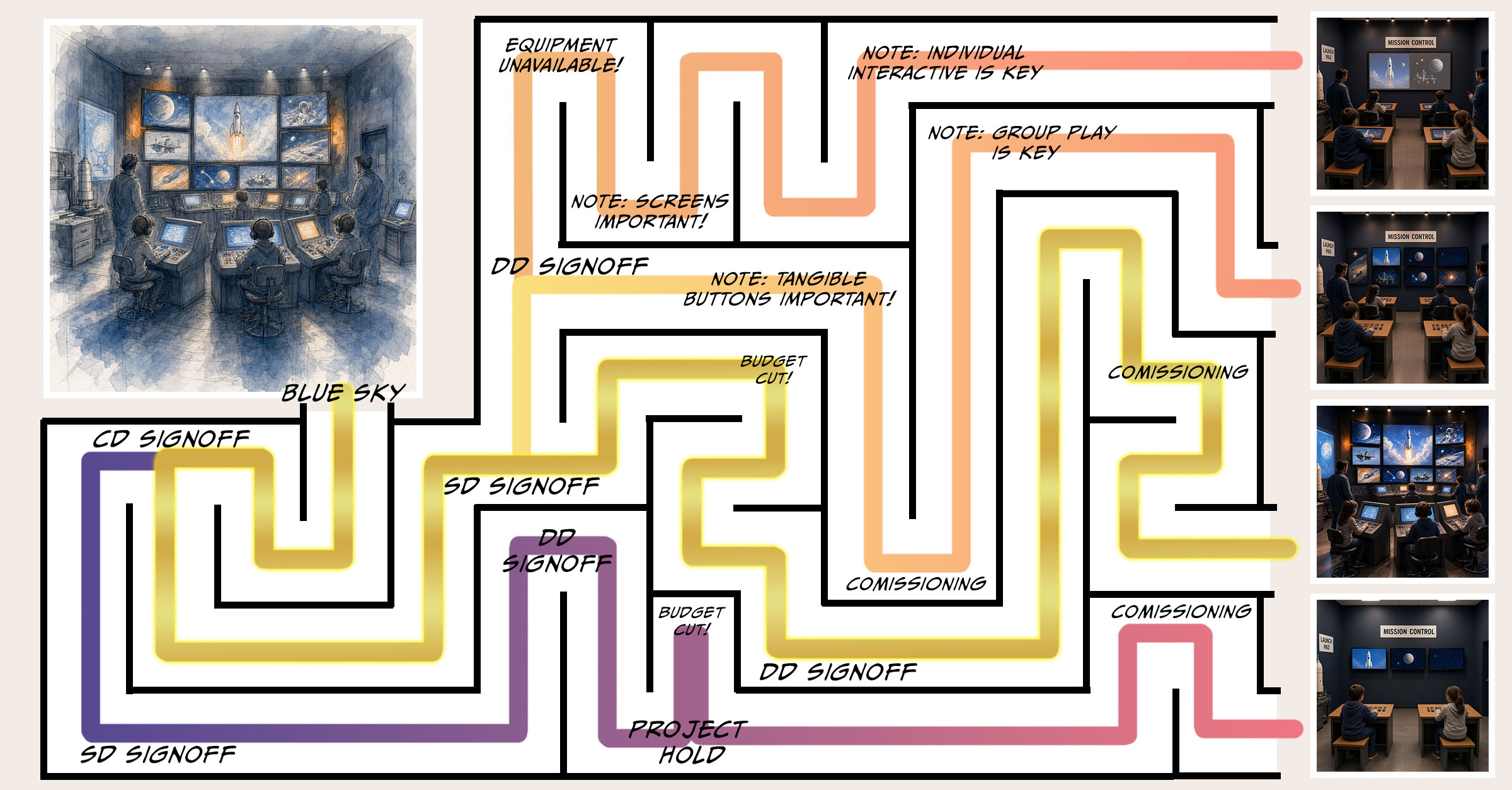
Most misalignments are found in the forks. Tacking on interactives at the very end with an expectation that they will meaningfully enhance the expereince. Budget cuts removing an element that was doing real work. An integrator's workaround solving their constraint, but ultimately limiting what the visitor can do. Operations simplifying a morning procedure because the original version ate the whole start-of-day window in their real staffing environment. None of those decisions are wrong in the room they were made. They're only a problem if their impact to the experience isn't examined and planned for.
In the case of permanent installations, the mid-tour slump of events is more of a long, slow decay after opening. The handoff to operations is often a rushed knowledge dump. The manuals or videos (a large volume of deliverables) vary in detail and are separated by vendor. Getting a clear understanding of the connections between systems is difficult. And the overall intent is even harder to keep in focus when you're just trying to understand how the equipment is supposed to work.
The people left holding it often can't see the whole picture of the experience, especially the nuances of the creative vision, from what's in front of them. They weren't involved in every design or review meeting, and their charge is simply to keep it running. Along the way, the expereince will start to land less for the audience. The ambition of the expereince won't get recalibrated after opening, it'll just try to survive until it gets replaced in 10 years.
The work is always a chain of translations. Creative intent becomes a spatial concept, then a system, ultimately something someone has to run at 7am with the staff they actually have, and hopefully something that turns a profit in the years after opening.
Doing it well meant rapport with the other disciplines, actually appreciating what each of them contributes, seeing the big picture from its components, and building in the handles across disciplines for flexability when the unforseen (or forseen) future issues arise.
That's what I call experience architecture. It starts by asking a different question up front: what this is meant to make more likely in the people who move through it? Then ensuring the project is still aligned through every handoff. It informs the flexibility that's needed in the experience (in the story, the systems, the facilities, the sets, the operations protocols) and keeps front and center the metrics and tools of making it matter, not just work. This may not prove transformation the way a load calculation proves a beam... What it does is make the intent and actual expereince traceable once the people who held the instinct have moved on.
The industry is looking to make more impactful experiences, I think it starts here. Respect the staff who inherit the thing. Plan clear systems for operations and improvement past opening day. Leave the owner and their team real leeway, so they feel capable and equipped to make tweaks over time.
This is a discipline that complements the designers and producers already on the build. (It doesn't replace them.) The goal is to build systems that protect the integrity of its environment, owns its creative intent, and leaves space for people to find themselves in it (and hopefully leave something of themselves there too). For a long time I've filled that gap by stepping outside whatever role I'd been hired into. Most anyone who's worked with me has seen it. It works, more or less, but it's also a bad system. Continuity that relies on one person noticing, also having enough standing to say something, and being able (and willing) to step in and fill what sat between seats is fragile in ways you don't see until that person leaves.
Opening day isn't the finish line, that's when your method and systems become most relevant, and where the business side of the enterprise succeeds or fails. There is a different way. Content you can update without a lengthy and expensive fabrication cycle. Systems that fail in a way you can see and understand. Documentation that says what an element does for the visitor, not only how to repair it. Tracked signals of visitor's investment in the expereince (do they care?), without having to track the visitor themself. Having the ability to learn and test without treating every post-opening change as a crisis.
Tertiary Co. is the practice I built around this work. We make the tools and systems to help clarify the intent before design commits, hold that intent through the gauntlet of translations (including that messy handoff to operations), and keep it alive and aligned after handover. It's for museums, themed entertainment, and immersive venues. The people already on the build stay on the build, we give them a method and set of tools to protect the intent from first conversation through opening and maintain its vision for years after the build team has moved on.