The Tertiary Method™
A structured approach to designing experiences backward from the change that actually matters.
The three layers
Any designed experience operates on three layers at once.
-
Primary
What you build. Space, content, technology, staff protocols, and how people move through it.
-
Secondary
What visitors do. Actions, interactions, and engagement patterns most organisations measure.
-
Tertiary
What they carry forward, and where it goes. Lasting change standard metrics struggle to see.
Most experience design focuses on the primary, measures the secondary, and hopes for the tertiary. We design for the tertiary from the first conversation.
That change is a shift in what feels possible. We work craft and systems in the same conversation.
Designed early. Proven late.
What gets built for year eight is specified while the project is still movable.
Living documentation is part of how we deliver. Next: the Experience Operations Platform for operators, and the Experience Performance Platform that inspects experience quality.
Technology
Empower, not extract.
Technology should empower people inside the experience, not extract from them. We explore what is additive, place it where it belongs, and keep dignity as the floor.
Seen, not surveilled.
Visitor sensing and personalization without surveillance. Session bounded data. Aggregate sensing. No covert biometrics. Trust produces better experiences.
Questions
Common questions about the method
What is the Tertiary Method™?
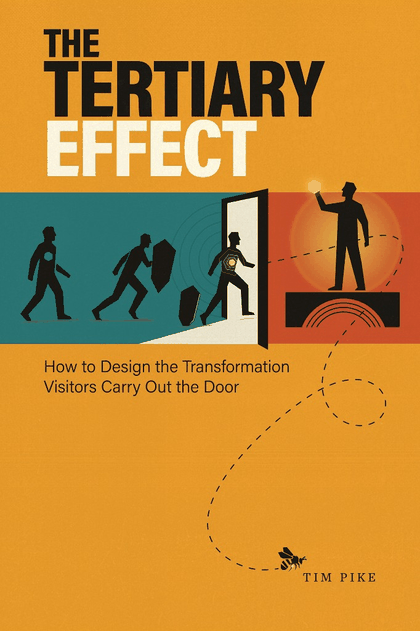
A way of designing experiences backward from the change that actually matters. Any designed experience operates on three layers. We design for the tertiary, what visitors carry forward, from the first conversation. The full method is set out in The Tertiary Effect, forthcoming late 2026.
Can transformation actually be measured?
Yes, though not with exit surveys and dwell time, and not with the same assurance as calculating if a beam can carry a load. Transformation is private, often delayed, and it resists the instruments institutions usually run on. Signal-based measurement, paired with machine learning trained on the language of transformation, turns faint and scattered signals into something you can act on. Without surveilling anyone.
Does this only work for big budgets?
No. The method scales because it's a way of making decisions, not a line item. Naming the change an experience is meant to make more likely sharpens a small project as much as a large one. Some of the most effective moves it produces cost nothing to build.
Are you for or against AI in visitor experiences?
Neither position survives contact with a real project. Used well, AI and machine learning are additive: more ways for different people to find meaning in the same environment, less staff time lost to the tedious, more capacity to adapt when the day does not go as drawn. Technology should empower the people inside the experience, not extract from them. Where it widens discovery and dignity, we design with it. Where it manufactures emotion or surveils, we design around it.
What does "seen, not surveilled" mean?
Visitors should be recognized by an experience without being identified or tracked by it. That is recognition without identification: session bounded data, aggregate sensing, no covert biometrics. It's a design position rather than a compliance posture, and it produces better experiences, because a visitor who trusts the room opens to it.
Do you have vendor partnerships?
No. We're hardware and software agnostic on purpose. We specify and recommend based on the project, not on partnerships, and we don't take referral fees.
We're being pitched a new technology. How should we evaluate it?
That is a service we offer. We evaluate whether the technology belongs in the experience, how it might be applied, and what guardrails keep it responsible. Ask what it makes possible for the visitor that wasn't possible before, what it takes from them, and who it's really for. If the pitch answers the first question with a feature list, the second with silence, and the third with "marketing," you already have a signal. We can run the full evaluation with you.
Are you building tools for after opening day?
Living documentation that connects systems to creative intent is already part of how we deliver. In development: the Experience Operations Platform, a knowledge system for operators when something fails, and the Experience Performance Platform, an inspector for experience quality against creative intent. Conversation welcome.